











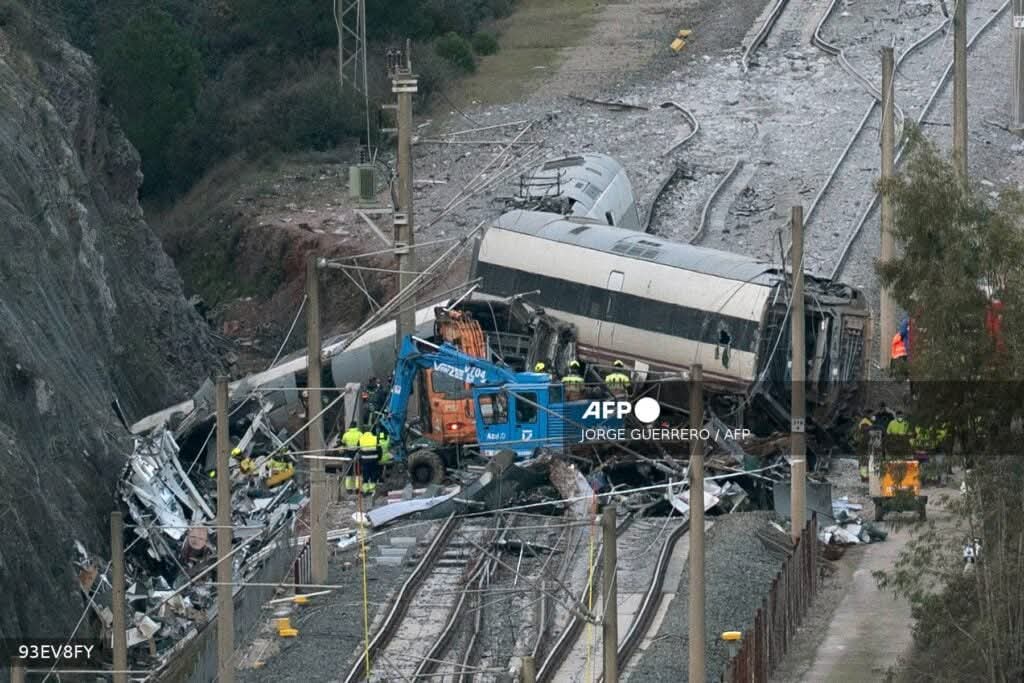
A commuter train near Barcelona struck debris from a collapsed retaining wall on Tuesday, killing one passenger and injuring dozens in Spain’s second fatal rail incident within days.
The crash occurred in the municipality of Gelida, about 40 kilometres west of Barcelona, after a wall gave way and fell onto the tracks, according to Catalonia’s civil protection agency. Regional Interior Minister Nuria Parlon confirmed that one person died and 37 others were injured, with five listed in serious condition. Authorities said the identification of the deceased was still ongoing.
Emergency responders worked through the night, using torches to inspect a derailed carriage that was left badly mangled. Spain’s rail infrastructure operator, Adif, attributed the collapse to severe weather and announced the suspension of Catalan commuter train services.
The latest accident comes just two days after a devastating high-speed train collision in southern Andalusia that killed 42 people and injured more than 120, making it Spain’s deadliest rail disaster in over a decade.
Earlier on Tuesday, King Felipe VI and Queen Letizia visited the site of Sunday’s collision near Adamuz and later met survivors receiving treatment in a hospital in Cordoba. Dressed in dark clothing, the royal couple spoke with emergency workers and expressed solidarity with victims and their families.
“I wanted to convey the affection of the entire country,” King Felipe said after visiting the injured.
One survivor, Portuguese national Santiago Salvador, who suffered a broken leg, described the impact as terrifying. “I was thrown through the carriage. It felt like being on a carousel,” he said, adding that the scene inside the train was “like hell.”
Spain has entered three days of national mourning, with flags flying at half-mast. The government has pledged a full and transparent investigation into the Andalusia crash. Officials said the trains involved were operating within permitted speed limits on a straight section of track, while investigators are examining reports of a crack in the rail.
Authorities have ruled out sabotage, and human error is said to be unlikely. As a precaution, Adif has temporarily reduced speed limits on parts of the Madrid–Barcelona high-speed line while inspections continue.