



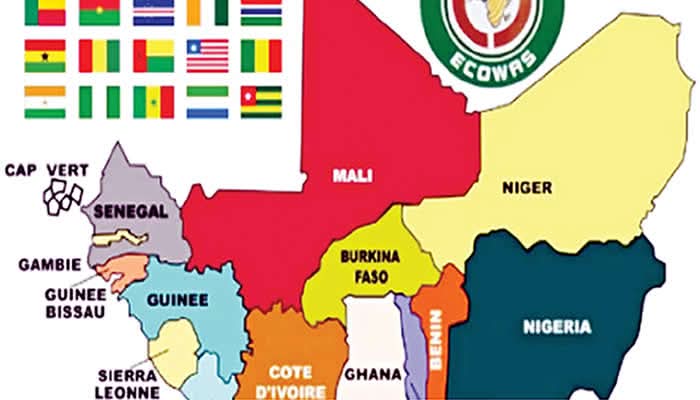
The Economic Community of West African States (ECOWAS) has said the withdrawal of Burkina Faso, Mali and Niger from the regional bloc is undermining collective counter-terrorism operations, even as it continues efforts to curb rising insecurity across West Africa.
President of the ECOWAS Commission, Omar Touray, made this known on Thursday in Abuja while presenting highlights of the organisation’s 2025 annual report during a meeting with development partners.
Touray said peace and security remain at the core of ECOWAS’ mandate, stressing that persistent insecurity in several parts of the region continues to pose major challenges.
“Across the different sectors of our activities, peace and security remain our primary concern, as some areas of the region continue to experience growing insecurity,” he said.
According to him, ECOWAS has strengthened its security architecture, including the ECOWAS Standby Force and a 1,650-member Counter-Terrorism Brigade. However, he acknowledged that the withdrawal of the three Sahel countries has weakened regional cooperation.
“We are also managing the implications of the withdrawal of Burkina Faso, Mali and Niger, while keeping the door open for constructive engagement,” Touray stated.
On counter-terrorism operations, he disclosed that ECOWAS has taken over the West Africa Police Information System from Interpol but noted that reduced collaboration with the Alliance of Sahel States has complicated joint security efforts.
“Although terrorist attacks declined slightly, fatalities increased due to the growing use of improvised explosive devices,” he added.
Touray also revealed that recent assessment missions to The Gambia and Guinea-Bissau exposed gaps in training and exit strategies, which the bloc is currently working to address.
He reiterated ECOWAS’ zero-tolerance stance on unconstitutional changes of government, strongly condemning a recent attempted coup in Benin Republic.
“ECOWAS condemned the incident in the strongest terms and intervened swiftly to send a clear message that coups are unacceptable in the region,” he said.
On political transitions, Touray said ECOWAS had called for a short, inclusive transition in Guinea-Bissau following the cancellation of elections, limited strictly to constitutional and electoral reforms. He also confirmed that Guinea has since been readmitted into the bloc after completing its electoral process.
Despite ongoing security challenges, Touray said the regional economy remained resilient, recording a growth rate of 4.6 per cent in 2025, with projections of five per cent growth in 2026.
“ECOWAS outperformed the continental average in 2025,” he said, attributing the performance to structural reforms, increased investment in mining and energy, improved trade facilitation, and a rebound in services, transport and tourism.
He added that inflation levels, fiscal deficits and debt-to-GDP ratios improved in several member states, while the region’s external position remained stable.
On regional integration, Touray said progress had been recorded in free movement and trade, with seven countries, including Nigeria, now implementing the ECOWAS National Biometric Identity Card. He also disclosed that a revised ECOWAS offer under the African Continental Free Trade Area had been submitted, with nearly all member states ratifying the agreement.
Touray further stated that ECOWAS committed about $8m to humanitarian response and disaster risk reduction, expanded drug rehabilitation services to 10 centres, and supported women and youth through capacity-building initiatives.
In the area of infrastructure, he said over $42m had been mobilised for regional road studies, including the Dakar–Abidjan corridor, while Côte d’Ivoire, Ghana and Nigeria were identified as regional internet exchange hubs.
Concluding, Touray said the bloc recorded notable progress despite political and security challenges.
“ECOWAS faced several challenges in 2025, but the progress achieved reflects the resilience, determination and unity of our community. A peaceful and integrated West Africa remains within reach,” he said.