



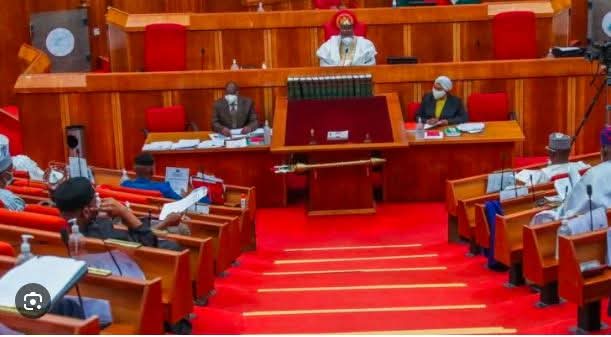
The Senate on Thursday interrogated key members of the Federal Government’s economic team for nearly five hours over concerns about Nigeria’s mounting debt, revenue forecasts and what lawmakers described as ambitious assumptions underpinning the proposed N58.472tn 2026 budget.
The session, convened by the Senate Committee on Appropriations and chaired by Senator Solomon Olamilekan Adeola, focused on details of the 2026 Appropriation Bill, including oil production targets, projected revenues, debt servicing obligations and the execution of previous budgets, especially capital releases to Ministries, Departments and Agencies.
The Minister of Finance and Coordinating Minister of the Economy, Wale Edun, told lawmakers that security spending had been given priority in the proposed budget. He disclosed that emergency funds had been released and that critical foreign payments for security equipment had been made multiple times this year, including recently.
Edun described the oil production benchmark of 1.84 million barrels per day as a “stretch target,” explaining that it was deliberately set high to encourage improved output. He maintained that as long as spending remained within available resources, fiscal stability would not be threatened.
Addressing Nigeria’s debt stock, estimated at about N152tn, the minister argued that the major challenge was not the debt-to-GDP ratio but the high interest rates charged on international borrowing. According to him, developing countries like Nigeria face steep borrowing costs in global markets.
He added that Nigeria currently chairs the technical group of the G24, where debt sustainability and rising interest rates are under review. Edun also noted that when the current administration assumed office in 2023, substantial resources were spent stabilising the economy, warning that undermining interest rate mechanisms could trigger exchange rate instability.
The Chairman of the Nigeria Revenue Service, Zacch Adedeji, cautioned against inflated revenue estimates, stressing that budget performance depends on realistic projections rather than the size of the spending plan.
He explained that under the Petroleum Industry Act, government revenue from oil production largely comes from taxes and royalties, since the Nigerian National Petroleum Company operates as a limited liability firm. High production costs, he said, reduce net earnings to the government.
In his remarks, Adeola urged the executive to present credible figures, pointing to significant gaps between projected and actual oil revenues in previous years. He questioned the rationale behind projecting improved performance when earlier targets had not been met.
The lawmaker suggested that reducing the size of the 2026 budget or disposing of certain government assets to cut down debt could help lower the overall debt burden and future borrowing costs.
Concerns were also raised about delays in funding capital projects under previous budgets. The Minister of State for Finance, Doris Uzoka-Anite, assured the committee that outstanding capital payments under the 2024 and 2025 budgets would be processed before March 31, 2026.
She said payments for 2024 capital projects would commence immediately, while MDAs had been directed to submit their 2025 cash plans to enable the release of funds once documentation requirements were met.
The meeting later went into a closed-door session, after which lawmakers adjourned further deliberations on the 2026 Appropriation Bill.
Also present were the Minister of Budget and Economic Planning, Atiku Bagudu, and the Accountant-General of the Federation, Shamsedeen Babatunde Ogunjimi.