











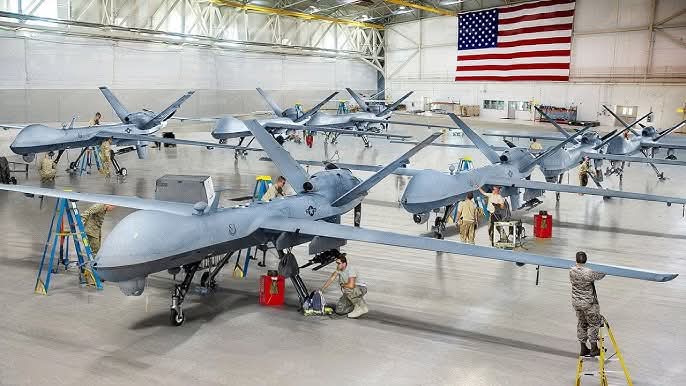
The United States has reportedly deployed several MQ-9 Reaper drones along with about 200 military personnel to Nigeria to assist in intelligence gathering and training as the country battles insurgency in its northern regions.
According to officials from both countries, the mission is strictly non-combat. U.S. forces are not embedded with Nigerian troops on the frontlines, and the drones are not being used for airstrikes. Instead, the focus is on surveillance and advisory support.
Sources told Reuters that the deployment followed a request from Nigerian authorities seeking enhanced support in identifying and tracking terrorist threats.
A U.S. defence official described the situation as a shared security concern, emphasizing that the operation is limited to intelligence collection and training.
Nigeria’s Defence Headquarters confirmed the development, noting that U.S. personnel are operating from an airfield in Bauchi State. The Director of Defence Information, Major General Samaila Uba, said the collaboration builds on a recently established joint intelligence fusion centre aimed at providing actionable intelligence to Nigerian commanders.
He reiterated that U.S. forces remain in a strictly supportive role, enabling Nigerian-led operations without direct combat involvement.
The MQ-9 drones, known for their ability to remain airborne for extended periods, are currently being used solely for surveillance, despite their capability to carry out strikes.
The deployment comes amid rising insecurity in Nigeria’s northeast and northwest, where insurgent groups such as Boko Haram and ISWAP continue to pose significant threats. Recent attacks, including a suicide bombing in a northeastern garrison town, highlight the persistent danger.
Military authorities say the duration of the U.S. mission will be determined jointly by both nations, with a focus on strengthening intelligence-sharing and improving Nigeria’s counterterrorism capacity.
This latest move follows earlier U.S. involvement, including reported airstrikes targeting extremist groups and a prior deployment of troops aimed at boosting Nigeria’s military capabilities through training and operational support.