




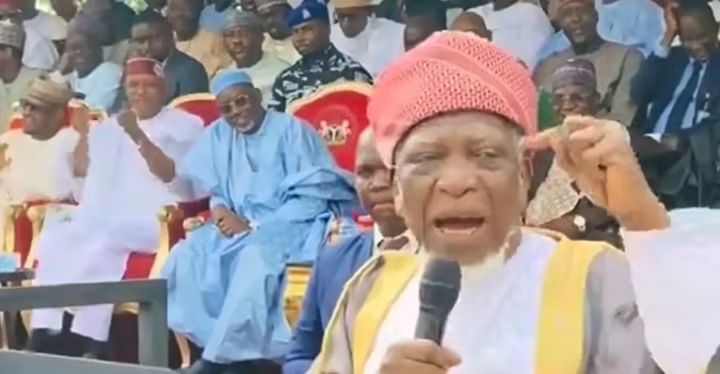
The Chairman of the Ulama Council of Jama’atu Izalatil Bid’ah Wa’ikamatis Sunnah, Sheikh Muhammad Jingir, has defended his support for a Muslim-Muslim presidential ticket, saying he has no regrets about his position.
Jingir made the clarification in an interview with the BBC published on Wednesday, following criticism of his recent comments advocating the continuation of the Muslim-Muslim political arrangement.
The cleric had recently spoken at a special wedding reception organised by the Kano State Government for 1,500 couples whose marriages were sponsored by the government. During the event, he urged Muslims to continue supporting Muslim-Muslim political arrangements and vote in a manner that reflects their numerical strength.
Explaining his position, Jingir said his advocacy was not specifically about President Bola Tinubu and Vice-President Kashim Shettima, but rather about what he described as the promotion of Islam and the interests of Muslims.
He stressed that his position predates the Tinubu administration and said he expected his comments to generate criticism.
“I am not promoting Tinubu, I am promoting Islam,” the cleric said, explaining that his views were based on his conviction about the challenges facing Muslims in Nigeria.
Jingir also argued that Christians had the same right to advise their followers on how to vote, insisting that he was equally entitled to advise Muslims on the exercise of their political rights.
He said his comments were not intended to provoke anyone, but were simply an expression of his opinion and religious conviction.
According to him, his position is rooted in the Islamic principle that Muslims are brothers to one another.
The cleric maintained that he had evidence to support his views and would continue speaking about them despite criticism.
He said he was aware that his position could attract controversy but remained unconcerned about the reactions.
Jingir was among the prominent Islamic scholars who supported Tinubu ahead of the 2023 presidential election after Tinubu selected Shettima, a fellow Muslim, as his running mate.
The decision resulted in Nigeria having its first Muslim-Muslim President and Vice-President since the country returned to democratic rule in 1999.
The Muslim-Muslim ticket has remained a major subject of political and religious debate in Nigeria, particularly as political parties and aspirants prepare for the 2027 presidential election.
Jingir’s latest remarks have already attracted reactions from several political figures and commentators, including National Coordinator of the Obidient Movement Worldwide, Yunusa Tanko, and Nigeria’s Ambassador-designate to South Africa, Femi Fani-Kayode.