

🇳🇬 1. 2027: Nigeria’s voter register projected to cross 100 million
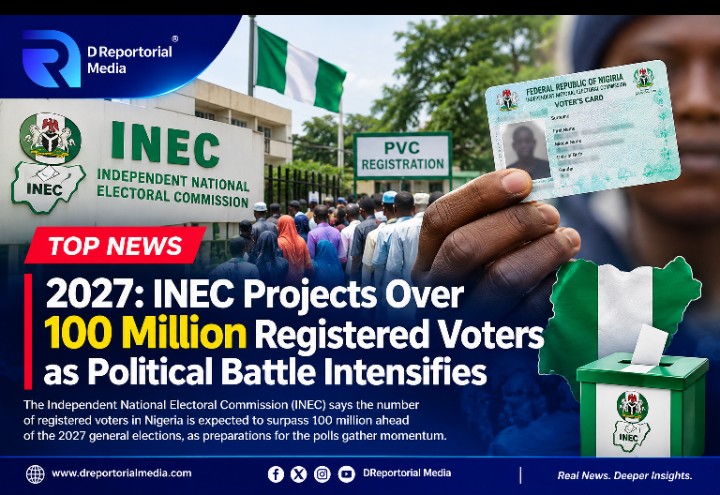
The 2027 general elections are already becoming a major focus across Nigeria as the Independent National Electoral Commission (INEC) prepares for the next nationwide polls.
INEC has projected that the number of registered voters will exceed 100 million ahead of the 2027 elections. The commission previously put the existing register at more than 93 million voters and said the recently concluded Continuous Voter Registration exercise would push the figure beyond the 100-million mark once the process is finalised.
INEC’s official platform currently lists more than 93 million registered voters, alongside about 176,000 polling units and 22 registered political parties.
The growing voter population is significant because the 2027 election is expected to generate intense competition, particularly for the presidency. President Bola Tinubu is seeking re-election, while opposition parties are also positioning their candidates and exploring possible alliances.
The size of the electorate will also increase the importance of voter education, registration verification and election technology as INEC works to strengthen confidence in the electoral process.
🇳🇬 2. 2027: Peter Obi backs Makinde, opposition unity gains momentum
The 2027 political contest received another major development on Monday after former Labour Party presidential candidate Peter Obi attended the commissioning of the Allied Peoples Movement (APM) presidential campaign headquarters in Abuja.
The APM is fielding Oyo State Governor Seyi Makinde for president.
Obi described Makinde as qualified to become Nigeria’s president and called for opposition forces to put political differences aside in the interest of the country.
Obi’s appearance at the event is particularly significant because he is himself running for president under the Nigeria Democratic Congress (NDC). His presence has therefore intensified speculation about possible discussions among opposition politicians ahead of the 2027 election.
Obi argued that Nigerians should be allowed to freely choose their preferred candidate in a credible election and that politicians should ultimately work together to address the country’s problems.
The development adds another layer to an increasingly crowded 2027 political landscape involving Tinubu, former Vice-President Atiku Abubakar, Obi, Makinde and other political figures.
⛽ 3. Makinde unveils “Reset Nigeria” agenda
Governor Seyi Makinde used the opening of his APM campaign headquarters in Abuja to formally promote his “Reset Nigeria” agenda.
Makinde said his campaign would focus on changing the way Nigeria manages its resources and economy.
One of the major issues he addressed was petrol pricing. He rejected suggestions that he was advocating a return to the old fuel-subsidy system, instead calling for a domestic crude-pricing framework that would ensure Nigerians benefit more directly from the country’s oil resources.
The governor argued that Nigeria’s position as an oil-producing country should translate into tangible benefits for citizens, particularly through more efficient domestic refining and transparent petroleum pricing.
His campaign is therefore likely to make the economy, fuel prices, poverty, employment and management of Nigeria’s oil resources major issues ahead of 2027.
🏛️ 4. South-South governors push regional economic integration
Governors from Nigeria’s South-South region have renewed efforts to strengthen regional economic cooperation.
At their second meeting in Calabar, Cross River State, the governors discussed infrastructure, investment, maritime development, industrialisation and security.
The region is strategically important to Nigeria because of its oil and gas resources, seaports, maritime economy and growing industrial potential.
🇳🇬 5. Sanwo-Olu engages South-West Arewa community
Lagos State Governor Babajide Sanwo-Olu on Monday hosted representatives of the South-West Arewa Community for the Renewed Hope Agenda at Lagos House, Ikeja.
The meeting focused on strengthening relationships between the Lagos government and the northern community living in the South-West.
Sanwo-Olu described the Arewa community as an important part of Lagos’ history and stressed the importance of continued engagement to promote unity and development.
The meeting also has a political dimension, coming as political parties and groups begin grassroots mobilisation ahead of the 2027 elections.
The governor commended the group’s grassroots mobilisation and its support for President Bola Tinubu and the Lagos State administration.
🗳️ 6. 2027 political realignment continues
Nigeria’s political landscape is increasingly dominated by preparations for the 2027 presidential election.
The emergence of multiple opposition candidates, discussions about possible alliances and the mobilisation of political support across regions suggest that the next election could produce a highly competitive contest.
The appearance of Peter Obi at Makinde’s campaign headquarters is particularly noteworthy because opposition unity has repeatedly been identified as a possible factor in determining whether the APC can be successfully challenged in 2027.
For voters, the major issues likely to dominate the campaign include:
Cost of living • insecurity • unemployment • fuel prices • electricity • corruption • poverty • federalism • regional development • electoral credibility.
⚽ 7. Falconets face Spain at U-20 Women’s World Cup
Nigeria’s Falconets are also in the spotlight today as they begin their campaign at the 2026 FIFA U-20 Women’s World Cup in Poland.
The Nigerian team faces Spain in its opening Group F fixture after completing preparations in Poland. Nigeria’s group also includes China and New Caledonia.
The match represents a major test for the young Nigerian side, with Spain regarded as one of the strongest opponents in the group.
The Falconets will be hoping to make a strong start to the tournament and build momentum for a deep run in the competition.