





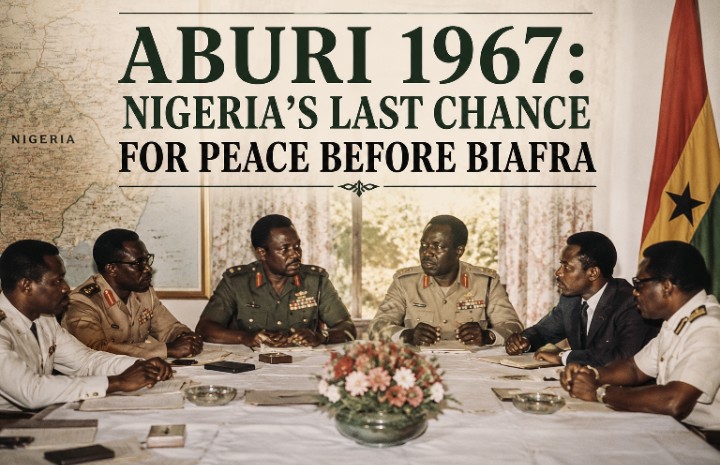
In the cool hills of Aburi, Ghana, in January 1967, Nigeria’s future sat trembling around a conference table.
The air was calm in the quiet Ghanaian town, far removed from the fear, bloodshed and suspicion tearing through Nigeria at the time. But behind the handshakes and military uniforms was a nation standing at the edge of collapse.
For two tense days — January 4 and 5 — Nigeria’s most powerful military leaders gathered in what many historians now describe as the country’s last real opportunity to avoid civil war.
At the center of the meeting were two men carrying the burden of a fractured nation: General Yakubu Gowon, Nigeria’s Head of State, and Lieutenant Colonel Chukwuemeka Odumegwu Ojukwu, the fiery military governor of the Eastern Region.
By then, Nigeria was already bleeding.
The January 1966 coup had shattered political trust across the country after prominent Northern and Western leaders were killed. Months later, a counter-coup claimed the life of military ruler General Aguiyi-Ironsi and unleashed deadly reprisals against Igbo civilians in Northern Nigeria. Thousands fled eastward in fear, carrying stories of massacres, abandoned homes and broken families.
The country was drifting dangerously toward war.
It was against this backdrop that Ghana’s leader, General Joseph Arthur Ankrah, stepped in, offering Aburi as neutral ground where Nigeria’s military rulers could attempt to salvage unity before it was too late.
The meeting itself was surprisingly cordial.
Photographs from Aburi showed smiling officers, relaxed conversations and moments of laughter — images almost impossible to reconcile with the catastrophe that would follow months later. For a brief moment, hope returned.
Around the table sat Gowon, Ojukwu, Hassan Katsina, David Ejoor, Mobolaji Johnson and other senior military officers representing Nigeria’s regions. They spoke not merely as soldiers, but as men trying desperately to hold together an artificial union already cracking under ethnic distrust and political rivalry.
After long discussions, an agreement emerged.
The leaders agreed that force should never be used to settle Nigeria’s crisis. They proposed a loose arrangement that would grant greater autonomy to the regions while reducing the powers of the central government. Decisions affecting the country would require collective agreement among regional leaders, easing fears of domination by any one ethnic group or region.
To many Easterners, especially Ojukwu, the accord represented safety, dignity and protection after months of violence against the Igbo people. To others within the federal side, however, the agreement appeared dangerously close to dismantling Nigeria altogether.
That difference in interpretation would become fatal.
When the leaders returned home, the fragile spirit of Aburi began to unravel almost immediately. Federal officials in Lagos feared the country was sliding toward confederation. Eastern leaders insisted the agreement had already settled the issue of regional autonomy.
Suspicion deepened. Trust evaporated.
Then came another explosive decision.
In May 1967, Gowon announced the creation of 12 states, breaking up the powerful regions — including the Eastern Region controlled by Ojukwu. To the federal government, it was a move to weaken regional tensions and protect minority groups. To Ojukwu and many Easterners, it was a betrayal of everything agreed upon in Aburi.
The final collapse came swiftly.
On May 30, 1967, Ojukwu declared the independent Republic of Biafra. Weeks later, Nigeria descended into a brutal civil war that would kill more than a million people, many through starvation and disease.
Nearly six decades later, the Aburi meeting remains one of the most haunting “what if” moments in Nigerian history.
What if the agreement had been fully implemented?
What if both sides had trusted each other just a little longer?
What if Aburi had succeeded?
Instead, the quiet Ghanaian town became forever linked to a failed peace — a place where war might have been prevented, but wasn’t.