









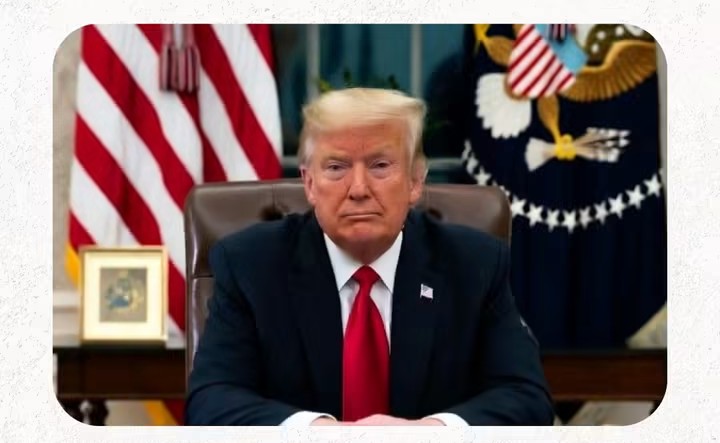
United States President Donald Trump has signed an executive order directing the renaming of Lake Ontario as “Lake America” for official federal purposes, in a move likely to further strain relations between Washington and Canada.
Trump signed the order on Thursday, directing the U.S. Department of the Interior and the Board on Geographic Names to begin the process of changing the name in federal records and government communications.
Under the directive, the Secretary of the Interior is expected to coordinate with the Board on Geographic Names within 30 days and take all appropriate steps to officially designate the water body as “Lake America” in U.S. federal records.
The order also requires officials to update the Geographic Names Information System (GNIS), replacing references to Lake Ontario with the new designation in federal maps, documents, contracts and official communications.
Trump justified the decision by pointing to the lake’s economic, military, commercial and historical importance to the United States.
The president said the move was consistent with his administration’s policy of recognising American achievements and highlighting landmarks considered important to the country’s heritage.
According to the executive order, the United States plays a major role in protecting the Great Lakes and maintaining the infrastructure that supports shipping, recreation and other activities across the freshwater system.
The document claimed that the U.S. Coast Guard operates nine of the 11 ice-breaking vessels serving the Great Lakes and provides security for commercial shipping routes.
The administration also stated that the United States had invested almost $4 billion in protecting the Great Lakes ecosystem over the past decade, while alleging that Canada’s investment in comparable initiatives was significantly lower.
Trump further described Lake Ontario as an important American economic and historical asset, citing its role in exploration, settlement, commerce and military activities.
The order referenced historical locations in New York, including Oswego and Sackets Harbor, which played roles in shipbuilding, naval operations and defence during the War of 1812.
It also highlighted the lake’s importance to the movement of goods and industrial products between the American interior, eastern markets and the Atlantic Ocean.
The wider Great Lakes-St. Lawrence Seaway system, the administration said, supports hundreds of thousands of jobs and contributes billions of dollars annually to the U.S. economy.
Major commodities transported through the system include iron ore, limestone, coal and agricultural products. Water from Lake Ontario is also used for power generation and supplies drinking water to communities in the surrounding region.
The order described the lake as a critical component of regional manufacturing, steel production, agriculture and energy supply chains.
Trump said the renaming was intended to recognise the lake’s economic significance and its contribution to the country’s future.
However, the U.S. decision does not compel Canada to adopt the new name.
Lake Ontario is a shared international waterway, with New York State bordering its southern and eastern shores while Canada’s Ontario province borders its northern, western and southwestern shores. Canada is therefore not legally bound by Washington’s decision.
The move comes only days after Trump first publicly raised the possibility of changing the lake’s name.
On August 25, he said his administration was giving “serious consideration” to renaming Lake Ontario, amid growing tensions between the United States and Canada over trade.
Relations between the two countries have deteriorated following failed trade negotiations and the introduction of new U.S. tariffs on Canadian goods, with Canada preparing retaliatory measures.
The latest decision also follows Trump’s earlier attempt to rename the Gulf of Mexico as the “Gulf of America,” another unilateral geographic naming initiative that attracted international controversy.
The Lake Ontario order states that it must be implemented in accordance with existing laws and is subject to the availability of funds. It also clarifies that the directive does not create new legal rights or benefits enforceable against the U.S. government.
The Department of the Interior will be responsible for the cost of publishing the order.
The development is expected to remain primarily a U.S. federal naming convention because Washington cannot unilaterally determine what Canada or international organisations call the shared waterway.
Meanwhile, tensions between the two countries continue to escalate.
Ontario Premier Doug Ford has previously warned that measures such as an electricity surcharge and restrictions on critical minerals supplied to the United States could be considered in response to Washington’s trade policies.
However, Alberta Premier Danielle Smith has ruled out disrupting Canada’s oil and gas exports to the United States as a retaliatory measure.
With Canada preparing to introduce its own retaliatory tariffs from September 8, businesses and consumers in both countries face the possibility of higher costs, supply-chain disruptions and increased economic pressure as the trade dispute deepens.