





1. 🇧🇯 Benin Steps Up Security Partnerships Amid Regional Tensions
Security remained one of the major issues in Benin Republic this week as the government intensified engagement with international and regional partners.
The Ministry of Interior and Public Security held discussions with the African Union and the Hanns Seidel Foundation on September 3 as part of efforts to strengthen cooperation in the security sector. The government said the engagement forms part of its broader efforts to improve internal security and address emerging security challenges.
The development comes at a time when insecurity and political tensions remain major concerns across the wider Sahel and West African region.
2. 🇧🇯 Benin-Niger Tensions Return to the Spotlight
Relations between Benin and neighbouring Niger again attracted attention following the attempted military uprising in Niamey on August 28–29.
Nigerien authorities have made allegations involving foreign actors, including Benin, in connection with the attempted destabilisation. However, the allegations have not been independently established. Reports indicate that Niger’s military authorities have been pursuing a broader narrative of foreign involvement in the attempted uprising.
The development is significant for Benin because relations between Cotonou and Niamey have been strained since Niger’s 2023 coup and the subsequent closure of the border.
Benin’s approach has increasingly emphasised dialogue and regional cooperation rather than escalation.
3. 🎓 2026/2027 School Year: Benin Intensifies Preparation
Education was another major focus this week as Benin prepared for the 2026/2027 academic year.
Secondary Education Minister Clément Adéyèmi Kouchadé continued consultations with education stakeholders in the Ouémé and Plateau departments ahead of the new school year. Discussions focused on the challenges facing the education sector and priorities for improving learning outcomes.
Earlier in the week, the minister identified three major priorities: improving students’ academic performance, promoting science education and improving working conditions for teachers and administrative staff. He also called for greater encouragement for girls to pursue science-related subjects and careers.
The government is also continuing infrastructure development, including the construction of 60 new classrooms at CEG La Verdure in Ouèdo, Abomey-Calavi, aimed at accommodating growing student numbers.
4. 🌡️ Benin Launches Climate-Health Resilience Project
Benin launched the SAP055 project this week to strengthen the ability of vulnerable communities to cope with the health consequences of climate change.
The project was officially launched on September 3 in Cotonou and targets communities within the Adjohoun-Bonou-Dangbo health zone in the Ouémé department.
The initiative focuses on strengthening health-system resilience in communities vulnerable to climate-related risks.
This is particularly important for communities exposed to flooding and other environmental pressures, where climate events can worsen health problems and put additional pressure on healthcare facilities.
5. 🌾 Agriculture Remains Central to Benin’s Development Agenda
Agriculture continues to feature prominently in Benin’s economic-development strategy, particularly as the country seeks to strengthen food security, agricultural productivity and rural livelihoods.
The government’s broader agricultural policies focus on increasing production, improving agricultural value chains, strengthening climate resilience and improving access to financing for farmers.
The renewed focus comes as climate change, food prices and regional insecurity continue to create challenges for agricultural communities.
6. 🏥 Government Reviews Health Infrastructure and Emergency Services
Health also featured prominently in the week’s government activities.
The government highlighted efforts to strengthen healthcare infrastructure and address urgent health needs, with Health Minister Benjamin Hounkpatin visiting several health facilities as part of efforts to assess critical services and infrastructure. The government listed the activity among its major updates at the beginning of the week.
The focus reflects the government’s continuing effort to improve healthcare delivery and ensure that health facilities are better equipped to respond to emergencies.
7. 🇧🇯 Ten Afro-descendants Receive Beninese Nationality Certificates
A notable social and cultural development this week was the presentation of Beninese nationality certificates to 10 Afro-descendants.
The certificates were presented on September 1, with the government describing the initiative as allowing the beneficiaries to reconnect with the land and heritage of their ancestors.
The development is part of Benin’s wider efforts to strengthen historical and cultural links with people of African descent around the world.
📰 D REPORTORIAL MEDIA WEEKLY SUMMARY
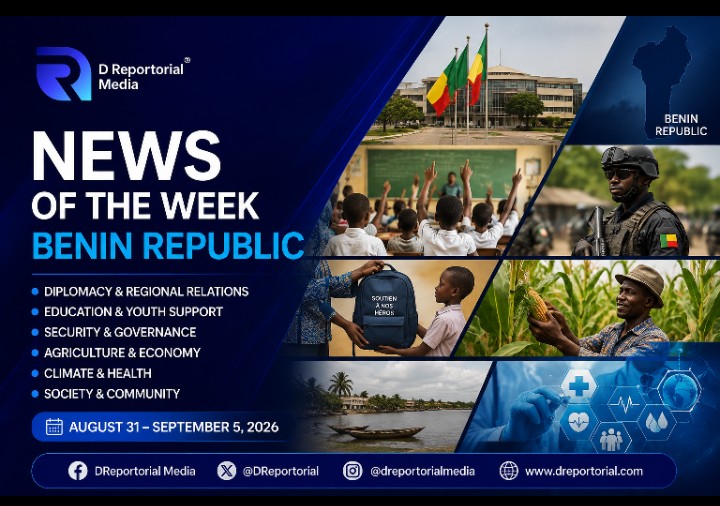
The week’s major developments in Benin Republic were dominated by security, education, healthcare, climate resilience and regional diplomacy.
The continuing developments around Benin-Niger relations remain particularly important because of their implications for regional stability and cross-border trade. At the domestic level, the government’s preparations for the 2026/2027 school year, security partnerships and the new climate-health project demonstrate an emphasis on strengthening public institutions and community resilience.
D REPORTORIAL MEDIA
“Your Trusted Voice for Development, Governance and Society.”
*Note: I have tightened the roundup to stories that I could verify from current Beninese government and credible regional reporting. Some figures and claims in my earlier list—such as the reported CFA30 billion education allocation and 2,000 maize farmers—were not sufficiently verified in the current search, so I have not presented them as established facts.*