








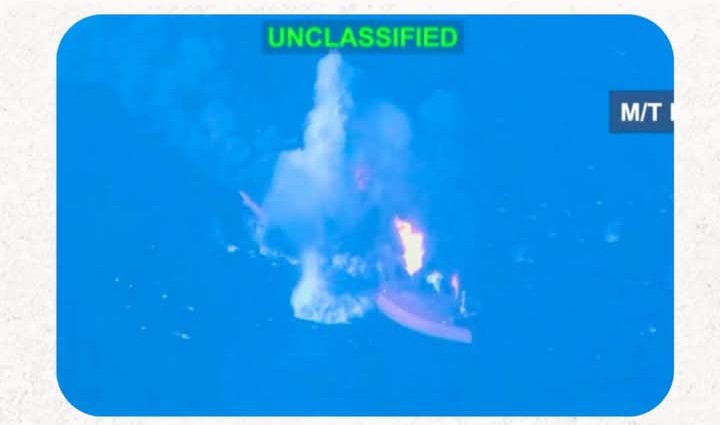
The United States military has struck and disabled three Iranian crude oil carriers after accusing Iran’s Islamic Revolutionary Guard Corps (IRGC) of launching ballistic missiles at two US Navy warships in the Middle East.
The latest exchange marks a fresh escalation in the prolonged confrontation between Washington and Tehran, with the United States warning that it could take further action against Iran’s oil fleet.
The US Central Command (CENTCOM), in a statement issued on Saturday, September 5, 2026, said its forces carried out the strikes after an American aircraft carrier and a guided-missile destroyer evaded what it described as multiple “unprovoked Iranian attacks.”
CENTCOM said no American personnel were injured in the incidents.
According to the command, US forces permanently disabled the M/T Downy off the coast of Kharg Island and the M/T Stark 1 near Jask.
The US military also targeted the unladen crude oil carrier M/T Kylo, also known as the Noxen, in the Gulf of Oman after its crew had been ordered to abandon the vessel.
CENTCOM said the vessel was hit at several critical points to ensure that it could no longer operate.
The US military alleged that the three tankers were connected to a multibillion-dollar “shadow network” allegedly used to generate revenue for the IRGC and its regional allies.
CENTCOM commander, Admiral Brad Cooper, described the strikes as a direct warning to Tehran.
“Let the message to the IRGC be clear: If you shoot at two of our ships, we will impose an even higher economic cost — taking out three of yours,” Cooper said.
He added that the United States would continue to defend its personnel and could destroy what he described as Iran’s “limited and exposed oil fleet” if necessary.
Conflict Intensifies
The latest strikes add to months of military confrontation between the United States, Israel and Iran.
The conflict began with a major US-Israeli offensive against Iran on February 28, 2026. Washington and Tel Aviv carried out coordinated attacks on Iranian military, nuclear and leadership targets, with the United States saying the operation was designed to weaken Tehran’s nuclear and ballistic-missile capabilities.
Iran responded with missile and drone attacks against Israel and US military facilities across the region.
Since then, the confrontation has developed into a sustained cycle of attacks and counter-attacks, including strikes against Iranian military infrastructure, attacks on American positions and renewed tensions around the strategically important Strait of Hormuz.
A temporary diplomatic arrangement reached in June failed to bring a lasting end to the hostilities.
Iranian President Masoud Pezeshkian said earlier in the week that Tehran was prepared to reciprocate US commitments under the interim agreement, but Washington has continued to demand additional concessions from Iran.
Strait of Hormuz Under Pressure
The latest tanker strikes also follow renewed American military activity around the Strait of Hormuz.
US forces recently struck Iranian rocket launchers on Larak Island, saying the weapons posed a threat to international shipping.
Iran subsequently launched missiles at US positions in Jordan, while Jordanian authorities said eight missiles were intercepted.
The United States has maintained a significant military presence across the Middle East, with more than 50,000 American service members reportedly deployed in the region, according to the Pentagon.
Washington has increasingly focused on Iranian maritime capabilities and vessels it says are linked to Tehran’s financing networks.
US officials have defended the military campaign as necessary to protect American personnel and international shipping.
Iran, however, has consistently condemned the US military presence and strikes as acts of aggression against its territory.
Possible Impact on Global Oil Markets
The latest attacks on Iranian oil tankers could put additional pressure on global energy markets, particularly because the confrontation remains closely tied to the Strait of Hormuz, one of the world’s most important routes for oil shipments.
The escalation comes as diplomatic efforts between Washington and Tehran remain stalled.
The United States has demanded that Iran halt attacks on shipping and accept broader restrictions, while Tehran has called for sanctions relief and an end to American military pressure before agreeing to significant concessions.
By directly targeting vessels that Washington says are involved in financing the IRGC and its regional allies, the latest operation represents a significant expansion of the economic dimension of the conflict.
The development has raised fresh concerns over the security of commercial shipping and global energy supplies as the seven-month confrontation continues to swing between military escalation and intermittent diplomatic efforts.