





A fresh funding crisis may be brewing in Nigeria’s public university system after a leaked internal memo revealed that the Federal Government under President Bola Tinubu directed federal universities to pay lecturers’ allowances using internally generated revenue, a move that has sparked fears of another round of tuition fee hikes across campuses.
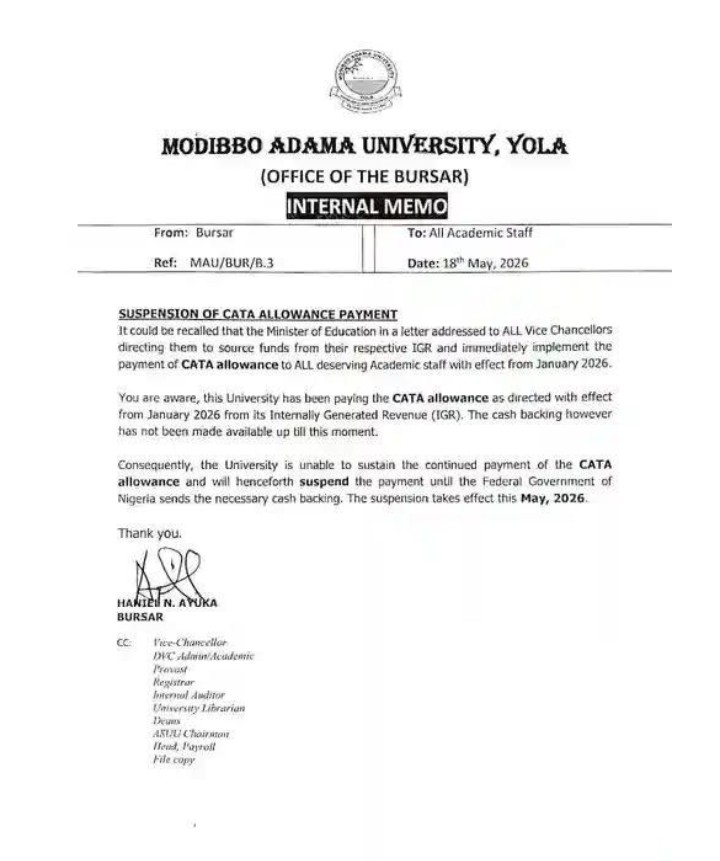
The directive, reportedly issued through the Federal Ministry of Education, instructed vice-chancellors to immediately begin funding the Consequential Adjustment and Transport Allowance (CATA) for academic staff from their institutions’ internal revenue sources.
The development came to light after an internal circular from surfaced online, detailing how the institution had struggled to comply with the directive without financial support from the Federal Government.
The memo, dated May 18, 2026, and signed by the university’s bursar, Hanien N. Ayuka, disclosed that the institution had been paying the allowance from its internally generated revenue since January 2026 but could no longer sustain the burden due to lack of federal reimbursement.
According to the circular, the Minister of Education had directed all vice-chancellors to source funds internally and commence payment of the allowance to eligible academic staff beginning from January this year.
The university management explained that despite complying with the order, the expected federal cash backing had not been released.
As a result, the institution announced the suspension of the allowance effective May 2026, citing worsening financial pressure.
Copies of the memo were reportedly forwarded to principal officers of the university, including the vice-chancellor, deputy vice-chancellors, registrar, provost, internal auditor, university librarian, deans, payroll unit, and the local chairman of the .
A lecturer at the university, who spoke anonymously, said the policy had thrown many public universities into severe financial uncertainty, with managements now considering fee increases and additional service charges to survive.
According to the source, universities can no longer sustain statutory payments from internally generated revenue alone, especially amid rising operational costs and dwindling government support.
The lecturer warned that many institutions may increase tuition fees in the next academic session as they struggle to remain afloat.
The source also disclosed that discussions within the university management had already pointed toward possible fee adjustments in the coming session.
The development has triggered anxiety among students and lecturers, many of whom fear that another wave of tuition hikes could deepen the economic hardship already affecting Nigerian families.
In recent years, several federal universities across the country have increased tuition and administrative charges, prompting protests by students and labour unions who accused the government of gradually commercialising public education.
Meanwhile, the has continued to warn that poor funding of tertiary education could worsen conditions in Nigerian universities and potentially trigger another industrial crisis.
The union’s Nsukka Zone recently accused the Federal Government of failing to fully implement the 2025 ASUU-FGN agreement, warning that the situation could push lecturers toward another round of industrial action.
Speaking during a press conference at , the zonal coordinator, Comrade Christian Opata, alleged that the government had abandoned key aspects of the agreement signed with the union on January 14, 2026.
He criticised the failure to inaugurate the Implementation Monitoring Committee meant to oversee execution of the agreement and prevent bureaucratic delays.
The union also faulted the Federal Government over the proposed National Research and Innovation Development Fund announced by Education Minister , alleging that ASUU was excluded from discussions despite being a major stakeholder.
ASUU further argued that the proposed research funding structure contradicted previous agreements requiring at least one per cent of Nigeria’s Gross Domestic Product to be committed to research, innovation and development.
The latest controversy has further intensified concerns over the future of public university education in Nigeria as institutions grapple with shrinking government support, rising operational costs and mounting pressure from both staff and students.