












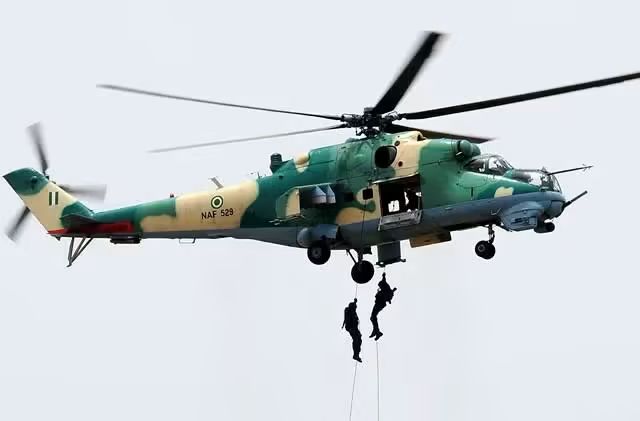
The Nigerian Air Force has reported the killing of nine fighters of the Islamic State West Africa Province, ISWAP, in an airstrike conducted in the Sambisa Forest area of Borno State.
The operation, carried out on Saturday, August 8, 2026, also reportedly eliminated a senior ISWAP commander identified as Abu Khalid Al Muhajir.
The NAF said the strike followed credible intelligence on the movement and activities of suspected terrorists within the forest.
In a statement issued on Sunday, the Director of Public Relations and Information, NAF Headquarters, Air Commodore Ehimen Ejodame, said a Remotely Piloted Aircraft was deployed to conduct sustained Intelligence, Surveillance and Reconnaissance operations in the area.
According to him, the surveillance operation enabled the military to track a group of terrorists as they moved towards a suspected hideout.
After confirming the target, the aircraft carried out a precision strike on the location.
Ejodame said a subsequent battle damage assessment indicated that the strike had caused significant damage to the targeted compound, with several terrorists neutralised.
He added that intelligence received after the operation confirmed that nine ISWAP fighters had been killed, while several others sustained injuries.
Among those killed, according to the NAF, was Al Muhajir, described as a prominent ISWAP commander responsible for providing special security escorts for senior members of the terrorist organisation.
The Air Force said the commander possessed extensive knowledge of routes, terrain and tactical movements connecting major terrorist enclaves in the Sambisa Forest and surrounding areas.
His death, it said, could therefore constitute a significant operational setback for the group.
The NAF further disclosed that intelligence suggested some of the terrorists targeted in the strike were linked to elements suspected of taking part in the recent ambush of Nigerian troops along the Bita-Yamtage axis in Gwoza Local Government Area of Borno State.
The military described the latest operation as another demonstration of the effectiveness of intelligence-led air operations, particularly the combination of persistent surveillance and precision strikes.
According to the NAF, the operation is expected to disrupt ISWAP’s leadership protection network, restrict the movement of high-value commanders and undermine the coordination of terrorist activities across its enclaves.
The service reaffirmed its commitment to conducting intelligence-driven air operations in collaboration with ground forces to degrade terrorist capabilities, limit their freedom of movement and enhance the security of communities across the North-East.