





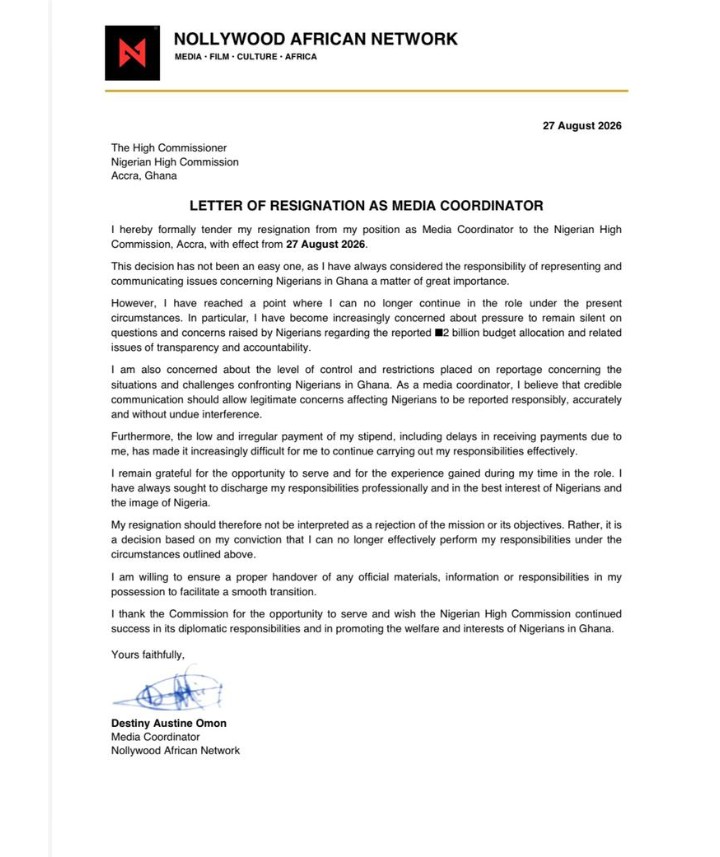
The Media Coordinator at the Nigerian High Commission in Accra, Ghana, Destiny Austine Omon, has resigned from his position, citing alleged pressure to remain silent on issues raised by Nigerians, restrictions on media coverage and irregular payment of his stipend.
Omon’s resignation took effect on Thursday, August 27, 2026, according to a resignation letter reportedly addressed to the Nigerian High Commissioner in Accra.
In the letter, Omon said his decision was not an easy one, noting that he considered representing Nigerians in Ghana and communicating issues affecting them an important responsibility.
However, he said he could no longer continue in the position under the prevailing circumstances.
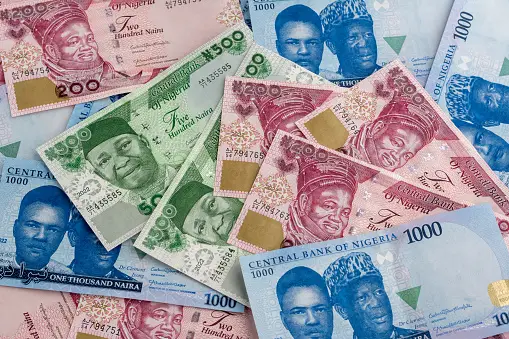
Omon specifically expressed concern over what he described as pressure to remain silent on questions raised by Nigerians regarding a reported ₦2 billion budget allocation and related issues of transparency and accountability.
He also alleged that restrictions had been placed on reporting issues and challenges affecting Nigerians living in Ghana.
According to him, such restrictions were inconsistent with his understanding of the responsibilities of a media coordinator, arguing that legitimate concerns affecting Nigerians should be communicated accurately and responsibly.
Omon further cited financial difficulties, saying the low and irregular payment of his stipend, including delays in receiving money owed to him, had made it increasingly difficult for him to effectively perform his duties.
Despite his resignation, the former Media Coordinator expressed gratitude for the opportunity to serve and for the experience gained during his time at the commission.
He maintained that he had always sought to discharge his responsibilities professionally and in the interest of Nigerians and the image of Nigeria.
A source familiar with the development told SaharaReporters that Omon’s resignation should not be interpreted as a rejection of the Nigerian diplomatic mission or its objectives.
The source said Omon remained committed to the Nigerian cause but believed he could no longer effectively perform his responsibilities under the circumstances he outlined.
Omon also offered to facilitate a smooth transition by handing over official materials, information and responsibilities in his possession.
Background to the ₦2bn Controversy
The resignation comes amid concerns raised by members of the Nigerian community in Ghana over the reported ₦2 billion allocation to the Nigerian High Commission in Accra.
Earlier, concerned Nigerians in Ghana reportedly petitioned the Federal Government, National Assembly and anti-corruption agencies, demanding greater transparency and accountability in the management of funds allocated to the mission.
The petition, dated August 18, 2026, was signed on behalf of the concerned Nigerians by Amb. Oloye Oyeyemisola Fatuyi FIIM, Baale of the Yoruba Community, Mataheko Afienya, Tema, and Chairman of the Greater Accra Yoruba Community, Ghana, alongside Nii Sakumono Okpelente 1 Noryaa Mantse of Greater Accra.
It was addressed to the Nigerian High Commissioner in Accra, the Minister of Foreign Affairs, the Senate President and the Speaker of the House of Representatives.
The petitioners demanded a detailed breakdown of funds allocated and released to the Nigerian High Commission under the 2025 Appropriation Act and any special intervention funds, particularly those intended for consular services and the welfare of Nigerians in Ghana.
They alleged that Nigerians in Ghana had repeatedly been required to provide financial support for matters they believed should ordinarily fall within the responsibilities of the High Commission.
According to the petitioners, such cases included emergency welfare assistance, repatriation support, detention-related matters and other consular interventions.
They alleged that Nigerians were sometimes asked to provide financial assistance on the grounds that the mission had “no available funds.”
The group said the situation raised serious questions about transparency, accountability and the management of public funds allocated to Nigeria’s diplomatic mission.
They also argued that the alleged practice placed an unfair financial and moral burden on Nigerians in Ghana, despite their contributions to Nigeria through remittances and their representation of the country abroad.
However, Omon’s resignation letter did not provide details on the specific ₦2 billion budget provision, its intended purpose or the identities of those he alleged had pressured him to remain silent.
As of the time of filing this report, the allegations contained in the resignation letter and the petition remain claims requiring responses from the relevant authorities.