












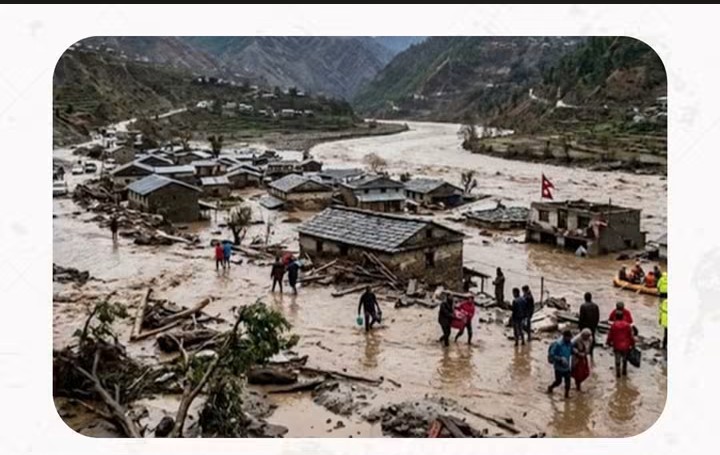
More than 1,300 people, including over 700 foreign nationals, have been reported missing following devastating floods triggered by a massive collapse of mud, rock, ice and debris in the Himalayan region bordering Nepal and China’s Tibet.
At least 165 people have been confirmed dead, with authorities warning that the figure could rise as rescue teams continue searching through areas devastated by the disaster.
Nepalese police and tourism officials said 826 people were missing within Nepal, including nearly 500 foreign nationals. Police spokesperson Abi Narayan Kafle said more bodies were expected to be recovered as search operations resumed.
Among the missing foreign tourists are 177 Indians, 63 Americans, 34 Australians, 33 Britons and 25 Canadians, according to officials.
Across the border in Tibet’s Gyirong County, Chinese authorities reported 558 people missing, including 260 foreign nationals.
The disaster occurred after a huge mass of ice, rock and mud collapsed into a Himalayan river, sending a powerful surge of water and debris through communities and transport routes.
Rescue teams in Nepal have deployed helicopters to search for survivors and deliver food, medicine and other emergency supplies to thousands of people stranded in the remote mountainous region.
More than 5,000 army and police personnel have been mobilised for the rescue operation. Army spokesperson Raja Ram Basnet said rescuers recovered 125 people on Thursday, including 20 foreigners.
Helicopters have also been used to distribute tents, food and medicines supplied by India to some of the worst-hit districts.
Nepal’s Prime Minister Balendra Shah travelled to Bidur in Nuwakot District to assess the destruction and review rescue efforts.
Possible Cause of the Disaster
Initial reports suggested that an earthquake may have triggered the collapse of part of a glacier, leading to the devastating flash floods.
However, the United States Geological Survey later said the seismic activity initially recorded as a magnitude 4.4 earthquake was actually seismic energy produced by the sudden collapse of glacial rock and ice, followed by a massive debris flow.
Chinese authorities have also warned that a lake upstream in Gyirong remains dammed, raising fears of additional flooding that could further complicate rescue operations.
Many of those affected were pilgrims travelling to Mount Kailash and Lake Mansarovar, important religious sites in Tibet revered by Hindus, Buddhists and followers of other faiths.
Indian spiritual leader Sadhguru, whose real name is Jagadish Vasudev, said about 77 Hindu pilgrims were at the Nepal-China border immigration office when the flooding struck.
The pilgrims were part of groups organised by the Isha Foundation, which Sadhguru leads. He said the incident was an “extraordinary” and devastating event.
International Assistance
The international community has begun responding to the disaster.
The United States said it would deploy a disaster response adviser and provide $500,000 in emergency assistance.
The United Nations also said emergency supplies and support personnel were being sent to affected communities in Nepal.
Canadian Prime Minister Mark Carney described the floods as devastating, while Australian Prime Minister Anthony Albanese said authorities were working to obtain reliable information from the remote disaster zone.
Sagar Pandey, chief executive of a Himalayan tourism company, said 15 Indian-Australian pilgrims travelling with his company were among those missing.
He described the affected area as almost completely destroyed, saying homes, hotels, restaurants and vehicles had been swept away.
In Nepal’s Rasuwa area, healthcare worker Tula Bahadur BK said settlements along the river had been completely destroyed and that five of his relatives remained missing.
Satellite imagery and aerial footage showed extensive destruction, including collapsed buildings, submerged vehicles, thick layers of mud and a bridge washed away by powerful floodwaters.
Rescue operations are continuing as authorities race to locate survivors and assess the full scale of the devastation across the Nepal-Tibet border region.