







A fresh controversy has emerged in the Nigerian Senate following the removal of Senator Natasha Akpoti-Uduaghan from the country’s delegation to the 2026 session of the Commission on the Status of Women (CSW) at the United Nations in New York.
The development has sparked debate as the global conference, which focuses on gender equality and women’s empowerment, began on March 9 with participation from government officials, activists, and policymakers across the world.
The situation has drawn attention to the role of Ireti Heebah Kingibe, the senator representing the Federal Capital Territory and Chairperson of the Senate Committee on Women Affairs.
Earlier during a Senate budget presentation session, Kingibe reportedly warned that she might boycott the conference if Natasha Akpoti-Uduaghan, the senator representing Kogi Central, was excluded from the delegation.
According to sources present at the session, Kingibe said, “If Senator Natasha Akpoti is not going to attend the programme, it means I am not going to attend too,” a statement widely interpreted as a show of solidarity with her colleague.
However, in a letter dated March 5, 2026, Kingibe clarified that only two senators had been officially nominated and registered for the event.
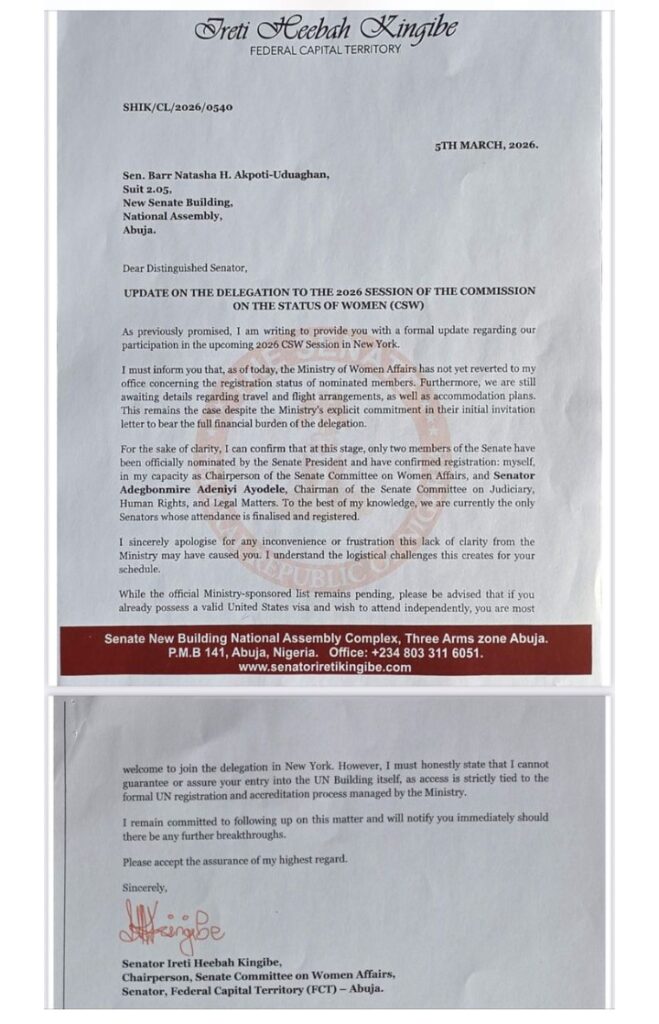
She stated that the confirmed nominees were herself and Adeniyi Adegbonmire.
Kingibe also explained that the Federal Ministry of Women Affairs had yet to finalise the full list of delegates or complete travel and accommodation arrangements for Nigeria’s team.
Despite this clarification, documents circulating within political circles suggest that Akpoti-Uduaghan may initially have been considered for the trip.
A WhatsApp message allegedly sent by an aide linked to Kingibe reportedly requested the international passport data page of the Kogi senator for the CSW programme in New York. The message asked her aide to provide the “principal’s data page,” a reference to her passport details.
Shortly after the request, an image of a passport data page was reportedly sent in response.
The development has fuelled speculation over what might have changed between the early preparations and the final selection of delegates.
Observers have also raised questions about representation at the conference, particularly as Nigeria has only a small number of female senators, including Kingibe and Akpoti-Uduaghan.
Critics argue that, given the focus of the conference on women’s issues, priority might have been given to female lawmakers actively involved in gender advocacy, rather than allocating one of the Senate-sponsored slots to a male legislator.
Meanwhile, Kingibe advised Akpoti-Uduaghan in her letter that she could still attend the conference independently if she already had a valid United States visa.
She wrote that while the ministry-sponsored list remained pending, the Kogi senator would be welcome to join the delegation in New York if she chose to attend on her own.
However, she noted that entry into the United Nations building would require formal accreditation from the Ministry of Women Affairs.
With the CSW conference already underway, the controversy has placed the spotlight on the Senate leadership and the Ministry of Women Affairs over the process used to select Nigeria’s representatives to the global women’s summit.
Analysts warn that the dispute could deepen tensions within the Senate and reignite debate about transparency, fairness, and gender representation in Nigeria’s participation at international policy forums.