












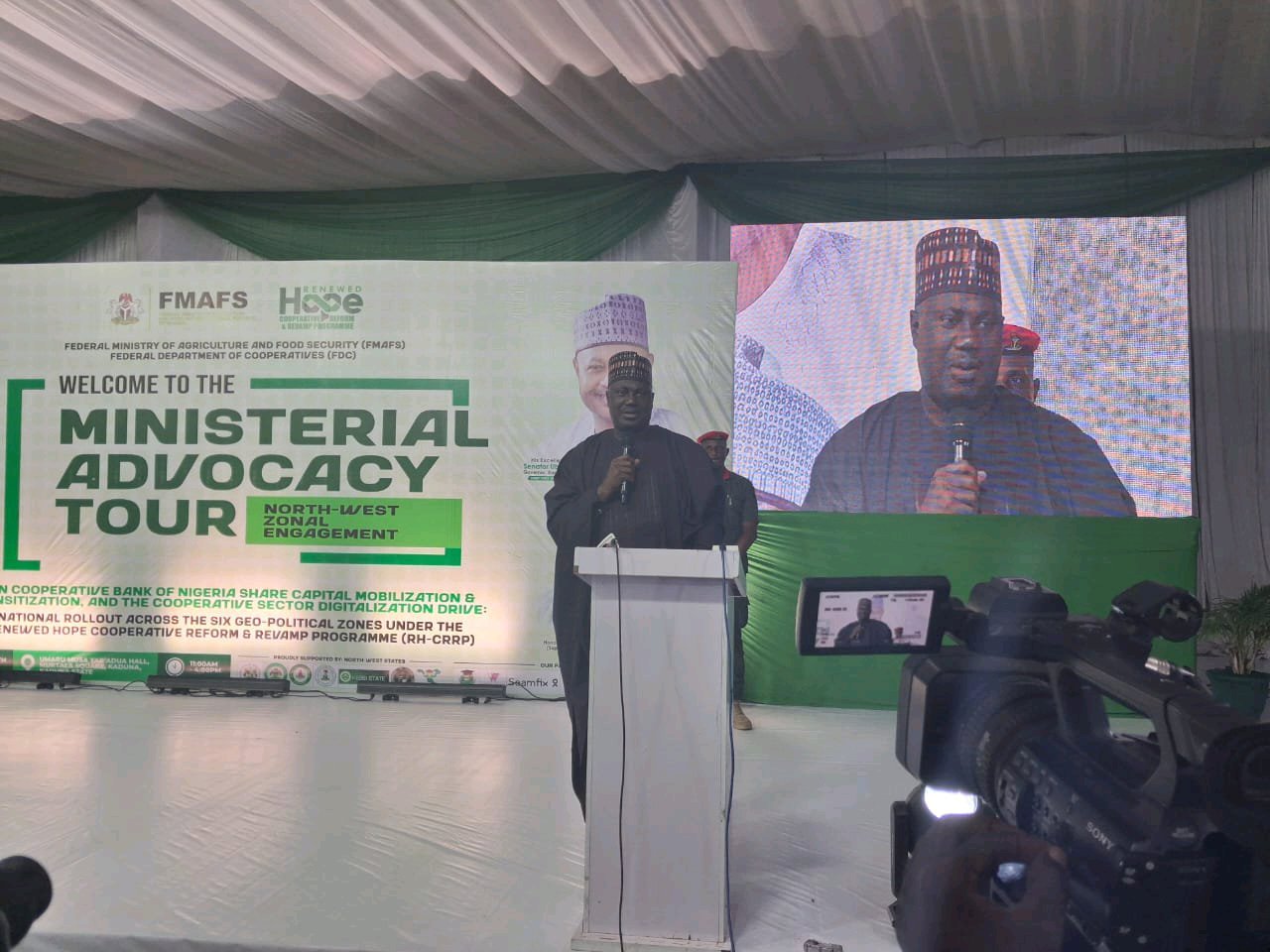
The Federal Government has unveiled a ₦200 billion share capital mobilization campaign aimed at establishing the proposed Cooperative Bank of Nigeria as part of the Renewed Hope Cooperative Reform and Revamp Programme (RH-CRRP).
The initiative was announced by the Minister of State for Agriculture and Food Security and Supervising Minister of Cooperative Affairs, Senator Aliyu Sabi Abdullahi, during the North-West Zonal Engagement of the Ministerial Advocacy Tour held at the Umaru Musa Yar’Adua Hall in Kaduna on Thursday.
According to the minister, the programme was approved during the 8th Regular Meeting of the National Council on Cooperative Affairs and is designed to strengthen Nigeria’s cooperative sector while expanding access to finance, promoting agricultural development, and supporting economic growth.
Abdullahi disclosed that the ministry plans to mobilize approximately 10,000 cooperative societies across the 36 states and the Federal Capital Territory through a structured investment framework. Under the arrangement, 1,000 societies are expected to contribute between ₦21 million and ₦50 million each, 3,000 societies will contribute between ₦16 million and ₦20 million, while 6,000 societies will invest between ₦1 million and ₦15 million.
He said the strategy is expected to generate about ₦200 billion in capital and provide a solid foundation for a nationally owned cooperative financial institution capable of supporting agriculture, enterprise development, housing, transportation, financial inclusion, value-chain development, and wealth creation.
“This programme is not a government project imposed from above. It is a movement-driven reform agenda designed to fulfil aspirations that cooperative stakeholders have expressed for decades,” the minister stated.
To ensure the sustainability of the initiative beyond the current administration, Abdullahi revealed that the ministry has established an Inter-Ministerial Technical Committee for policy coordination and a National Steering Committee comprising ministries, departments and agencies, cooperative organizations, and development partners. Dedicated desk officers have also been assigned to oversee the seven strategic pillars of the reform programme.
Providing details of the ownership structure of the proposed Cooperative Bank of Nigeria, the minister explained that 65 per cent of the bank’s equity would be owned by cooperative societies through the Cooperative Trust and Investment Society of Nigeria (CoopTrust). Another 30 per cent would be available to institutional investors, development finance institutions, impact investors, and individual cooperators, while the remaining five per cent would be reserved for an Employee Share Ownership Scheme.
Abdullahi also announced plans to introduce the National Cooperative Digital Architecture Platform (NCDAP), which will modernize and digitize the cooperative sector. The platform will feature a National Cooperative Smart Registry, a Cooperative Verification Number system, CoopID, and the CoopCHECK Credit Bureau powered by CreditRegistry.
“We cannot build a modern, globally competitive cooperative economy using outdated analog systems,” he said.
The minister noted that cooperative societies were instrumental in some of Nigeria’s most successful agricultural ventures in the past, including the famous groundnut pyramids, cotton production, and hides and skins trade in the North-West, as well as cocoa and palm produce cooperatives in the former Western and Eastern regions.
He urged cooperative federations, unions, societies, development partners, traditional institutions, and financial organizations to mobilize their members and actively participate in the programme.
Abdullahi further explained that the Kaduna engagement followed an earlier South-West zonal meeting in Lagos and forms part of a nationwide advocacy campaign to promote the RH-CRRP.
The minister commended Kaduna State Governor Uba Sani for sustaining the state’s reputation as a centre for commerce, education, agriculture, and innovation, noting that the governor’s commitment to security and social inclusion would provide a favourable environment for the programme’s success.
Speaking through the Commissioner for Agriculture, Murtala Dabo, Governor Sani described cooperatives as vital drivers of socio-economic development. He noted that cooperative societies have historically served as platforms for savings, access to credit, enterprise development, agricultural production, and community empowerment.
The governor added that as Kaduna State advances initiatives such as the Special Agro-Industrial Processing Zone, Agricultural Quality Assurance Centre, mechanisation programmes, climate-smart agriculture projects, and value-chain development schemes, digitally enabled cooperatives would play an increasingly important role in boosting productivity, competitiveness, and economic prosperity.
In his welcome address, the Provost of the Federal Cooperative College, Kaduna, Dr. Ibrahim Mohammad Awwal, said Kaduna was a fitting venue for the engagement because of its historic role in cooperative development in Northern Nigeria and its continued importance as a hub for cooperative education, training, research, and institutional development.
Also speaking, the President of the Cooperative Federation of Nigeria, Hannatu Mershak, emphasized the importance of digital transformation within the cooperative sector. She noted that digitization would improve record-keeping, facilitate access to markets and finance, and enhance confidence among government agencies, investors, and development partners.
The advocacy tour is part of the Federal Government’s broader efforts to reposition the cooperative movement as a key driver of economic growth, financial inclusion, and sustainable development across the country.