










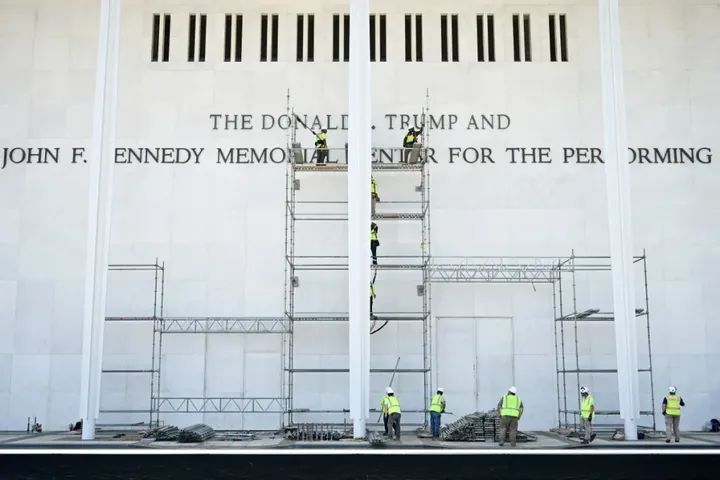
Workers have removed the name of U.S. President Donald Trump from the facade of the renowned John F. Kennedy Center for the Performing Arts in Washington, D.C., following a federal court ruling that declared the venue’s renaming unlawful.
The Kennedy Center confirmed on Saturday that all physical signage bearing Trump’s name had been taken down from the building and its surrounding grounds. Executive Director Matt Floca said the institution complied with the court order by removing every reference to Trump’s name from the property.
Earlier in the day, a white tarp covered the section of the building where the signage was being dismantled, while construction workers operated scaffolding to complete the task. Loud construction noises echoed around the area as passersby stopped to observe the removal process.
The action followed a legal setback for the Trump administration after a federal judge rejected a last-minute request by the center’s board to delay the removal. The ruling marked a significant challenge to Trump’s broader efforts to place his name and image on federal institutions since returning to the White House.
Crowds gathered outside the arts venue on Friday evening to witness the anticipated removal, with many cheering as workers prepared the site. Thousands more followed the event through online livestreams.
According to Floca, the removal process experienced delays due to thunderstorms that raised safety concerns for workers. Despite the weather-related interruption, officials moved ahead with the operation in compliance with the court’s deadline.
U.S. District Judge Christopher Cooper had ruled on May 29 that the decision to rename the Kennedy Center after Trump was unlawful because only Congress has the authority to change the name of the federally established institution. He ordered that Trump’s name be removed from the building and all associated materials within 14 days.
In addition to removing the signage, the Kennedy Center had earlier deleted references to Trump from its official website.
On Friday, Judge Cooper also dismissed an emergency appeal seeking to halt the implementation of his order. He further denied a request for a 12-hour extension, stating that the public interest was not served by prolonging what he described as unlawful government action.
The judge had previously issued a temporary injunction preventing the administration from proceeding with plans to shut down the Kennedy Center for two years of renovations, a project scheduled to begin in July.
The dispute stems from changes made after Trump assumed office for a second term. The president appointed himself chairman of the center’s board, which later voted to rename the institution the “Trump Kennedy Center.” His full name was subsequently installed in large capital letters above that of former President John F. Kennedy on the building’s facade.
The move sparked criticism from artists and cultural figures, with several performers cancelling scheduled appearances at the venue in protest.
The Kennedy Center controversy is part of a broader effort by the administration to associate Trump’s name and image with public institutions. Other federal entities have also featured prominent displays of the president’s likeness, while supporters have proposed placing his image on a commemorative $250 bill ahead of the United States’ 250th anniversary celebrations.
The removal of Trump’s name from the Kennedy Center represents the latest chapter in an ongoing legal and political battle over the use of presidential branding on public institutions.